
Offender Record · OFF-2026-042
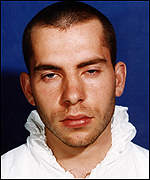
David Copeland (photo from the Radford University biography)
David James Copeland
Also known as London Nail Bomber
Sex
Male
Race
White
Born
1976
Custody
Incarcerated
States
GB
Distinguishing featuresDescribed as short in stature, which caused him to be teased at school and nicknamed 'Mr. Angry'
Custody
Incarcerated at HMP Belmarsh
Custody record at the facility
Sentenced June 30, 2000 to six concurrent life sentences; transferred to HMP Belmarsh from Broadmoor Hospital in 2004; minimum term set at 50 years as of March 2, 2007, making him ineligible for release until approximately 2049.
This record documents arrests, charges and convictions reported by courts, law enforcement agencies and news organizations. Every statement is tied to a cited source with an archived copy. A charge is an accusation, not proof of guilt; a person charged is presumed innocent unless convicted. Solve the Case does not allege that this person committed any offense beyond what the cited records state, and this record is not a suggestion that the person is connected to any unsolved case. How records are built, corrected and removed.
Summary of the record
David James Copeland was convicted of three counts of murder and three counts of causing explosions to endanger life in June 2000. Between April 17 and April 30, 1999, Copeland planted three homemade nail bombs in London targeting Black, Bangladeshi, and LGBT communities: at Brixton Market, on Brick Lane, and at the Admiral Duncan pub in Soho, killing three people and injuring 140. He was sentenced to six concurrent life sentences with a minimum term of 50 years. He is currently incarcerated at HMP Belmarsh in London.
Documented Arrests, Charges and Convictions
Dispositions are shown exactly as the cited records report them. Pending charges are updated when a court acts; a record with no remaining conviction or pending charge is removed from the site.
Offense date Apr 17, 1999, Brixton, London, England
Causing explosions to endanger life (Brixton)
Metropolitan Police Anti Terrorist Branch · Central Criminal Court (Old Bailey) · Docket 2000/HH Judge Hyam · Arrested May 01, 1999 · Convicted Convicted · Sentence: Life imprisonment (concurrent)
On April 17, 1999, Copeland planted a nail bomb in a sports bag outside a supermarket on Electric Avenue in Brixton, an area with a large Black population. The bomb contained approximately 1,500 four-inch nails and was detonated at approximately 5:25 p.m., injuring approximately 39-50 people, including a 23-month-old toddler.
SourcesCopeland, R v [2007] EWHC 368 (QB); 1999 London nail bombings; Copeland, R. v [2011] EWCA Crim 1711
Offense date Apr 24, 1999, Brick Lane, London, England
Causing explosions to endanger life (Brick Lane)
Metropolitan Police Anti Terrorist Branch · Central Criminal Court (Old Bailey) · Docket 2000/HH Judge Hyam · Arrested May 01, 1999 · Convicted Convicted · Sentence: Life imprisonment (concurrent)
On April 24, 1999, Copeland planted a nail bomb on Brick Lane in Spitalfields, an area with a large South Asian (Pakistani and Bangladeshi) community. An alert passerby noticed the suspicious sports bag and moved it to the trunk of a car to transport it to police. The bomb detonated during transport, injuring approximately 10-13 people.
SourcesCopeland, R v [2007] EWHC 368 (QB); 1999 London nail bombings
Offense date Apr 30, 1999, Soho, London, England
Murder
Metropolitan Police Anti Terrorist Branch · Central Criminal Court (Old Bailey) · Docket 2000/HH Judge Hyam · Arrested May 01, 1999 · Convicted Convicted · Sentence: Life imprisonment (concurrent), minimum term 50 years as of 2007
On April 30, 1999, Copeland planted a homemade nail bomb in a sports bag at the Admiral Duncan pub in Soho, in the heart of London's gay community. The bomb contained approximately 1,500 four-inch nails and was detonated at approximately 6:05 p.m., killing three people and injuring approximately 70-79 others.
SourcesCopeland, R v [2007] EWHC 368 (QB); 1999 London nail bombings; David John Copeland
Pattern and Background
Victim counts and the pattern of the offenses as stated by courts, agencies and the cited reporting. Suspected counts are what officials have said publicly, not a finding of this site.
3
Victims convicted
0
Victims confessed
0
Victims suspected
Active years
1999–1999
Victim profile
Strangers
Stated motive
Power or control, Mission or hatred of a group
Range from home
local
Confessed
Yes
Education
some high school
Marital history
Never married
Children
0
Places Lived, Worked and Frequented
Each place and date range comes from a cited record. Dates marked approximate are as reported. Know a place that is missing? Use Edit record under the photo; a moderator reviews it before it appears.
GB
Yateley, England, United Kingdom
1976 – 1992 · Childhood residence with parents and two brothers
Isleworth, England, United Kingdom
1976 – 1976 · Birthplace
Yateley, England, United Kingdom
approx. 1984 – 1992 · Yateley Comprehensive School; obtained seven GCSEs
Greater London, England, United Kingdom
1997 – 1998 · Jubilee Line extension project
Cove, England, United Kingdom
approx. 1998 – May 01, 1999 · Rented room on Sunnybank Road
Greater London, England, United Kingdom
May 01, 1999 – Jun 1999 · Maximum security prison on remand
Broadmoor, England, United Kingdom
approx. Jun 1999 – 2004 · Broadmoor Hospital high-security special hospital
Greater London, England, United Kingdom
2004 – present · HMP Belmarsh, Category A prison
Timeline
May 15, 1976
David James Copeland born in Isleworth, London.
1992
Copeland left school at age 16 and turned to drugs and alcohol.
1997
Copeland moved to London to work as engineer assistant on Jubilee Line extension project.
May 1997
Copeland joined the British National Party at age 21.
1998
Copeland joined the National Socialist Movement and became regional leader for Hampshire; prescribed anti-depressants.
Apr 17, 1999
Copeland planted first nail bomb outside supermarket on Electric Avenue, Brixton, injuring approximately 39-50 people.
Apr 24, 1999
Copeland planted second nail bomb on Brick Lane in Spitalfields, injuring approximately 10-13 people.
Apr 30, 1999
Copeland planted third and most deadly nail bomb at Admiral Duncan pub in Soho, killing three people and injuring approximately 70-79 others.
May 01, 1999
Copeland arrested at his rented room in Cove, Hampshire; he admitted to police he carried out all three bombings.
Jun 30, 2000
Copeland convicted of three counts of murder and three counts of causing explosions to endanger life; sentenced to six concurrent life sentences.
2004
Copeland transferred from Broadmoor Hospital to HMP Belmarsh.
Mar 02, 2007
High Court hearing fixed Copeland's minimum term at 50 years, making him ineligible for release until approximately 2049.
Jun 2014
Copeland attacked a fellow prisoner with a weapon made from razor blades and was found guilty of wounding with intent; three years added to his sentence.
Sources
Solve the Case is never the original source. Each item below is the public record a statement on this page rests on, with an archived copy where one exists.
Other · Murder Index ·
David John Copeland“After his arrest, Copeland told psychiatrists that he had started having sadistic dreams when he was about 12. He admitted carrying out the three bombings as soon as he was arrested.”
Other · PeoplePill ·
Who is David Copeland? British neo-Nazi (1976-)“Copeland was born in Isleworth, in the London Borough of Hounslow. His father was an engineer and his mother was a housewife.”
News report · A&E Television Networks ·
David Copeland: Where Is the London Nail Bomber Now?“Copeland was initially taken to the high security Broadmoor Hospital but was then transferred to Belmarsh prison in 2004. In 2007, due to new legislation, Copeland's sentence was increased to a minimum of 50 years.”
Other · Murderpedia ·
David John Copeland“Victims profile: Andrea Dykes, 27 (pregnant); Nick Moore, 31, and John Light, 32; Date of arrest: Same day; Status: Sentenced to six concurrent terms of life imprisonment on June 30, 2000”
Other government record · Wikipedia ·
HM Prison Belmarsh“David Copeland, neo-Nazi who bombed Brixton Market, Brick Lane, and a gay pub in Soho”
News report · Wikipedia ·
1999 London nail bombings“Copeland was arrested that night once the police obtained his address, a rented room in Sunnybank Road, Cove, Hampshire. He admitted carrying out the three bombings as soon as he opened the door to the police.”
Court record · The National Archives - UK Caselaw ·
Copeland, R. v [2011] EWCA Crim 1711“On 17 April 1999 the appellant left a holdall containing an improvised time bomb packed with a large quantity of nails outside a supermarket in Brixton next to a crowded bus stop.”
Court record · The National Archives - UK Caselaw ·
Copeland, R v [2007] EWHC 368 (QB)“David James Copeland was unanimously convicted on 30 June 2000 at the Central Criminal Court before the Recorder of London HH Judge Hyam and a jury, of 3 counts of murder and 3 counts of causing explosions in order to endanger life”
Other · Radford University Department of Psychology ·
Radford University serial killer biography: Copeland, David“Convicted of murder and sentenced to 6 life sentences; Born in Isleworth, London; Number of victims: 4 killed and 129 injured”
Other · NIH/PMC ·
No excuses“On Friday 30 June 2000 David Copeland was convicted on three counts of murder and three counts of causing explosions for which he received six life sentences.”
Discussion
Casual discussion about this record on the community forum. The facts live on this page: to add a place, a vehicle or a source, use the Edit record button under the photo so a moderator can review it. Please name no one else, never name a victim, and do not connect the person to any case not listed here.Open the topic on the forum
Corrections and removal. If a charge on this page has been dismissed, acquitted, overturned, pardoned or expunged, or any fact is wrong, tell us through the correction form. Corrections are free, reviewed within five business days, and a record with no remaining conviction or pending charge is removed. Information here may not be used for decisions about employment, housing, credit, insurance or any purpose covered by the Fair Credit Reporting Act, and never to harass, threaten or harm anyone. Where a source is an offender registry, that information is reproduced as of the date shown and is subject to the conditions of use of that registry.